

Top 10 Telecom Battery Manufacturers and Suppliers Worldwide

Telecommunications networks are the backbone of modern connectivity, supporting mobile communications, internet services, data transmission, and emergency communication systems. As telecom infrastructure continues to expand, reliable backup power has become essential for maintaining network availability during power outages and fluctuations.
Telecom batteries play a critical role in powering mobile towers, base transceiver stations (BTS), switching centres, transmission equipment, and other communication infrastructure. Choosing the right battery manufacturer involves evaluating reliability, backup duration, battery technology, operating conditions, service life, and supply capabilities.
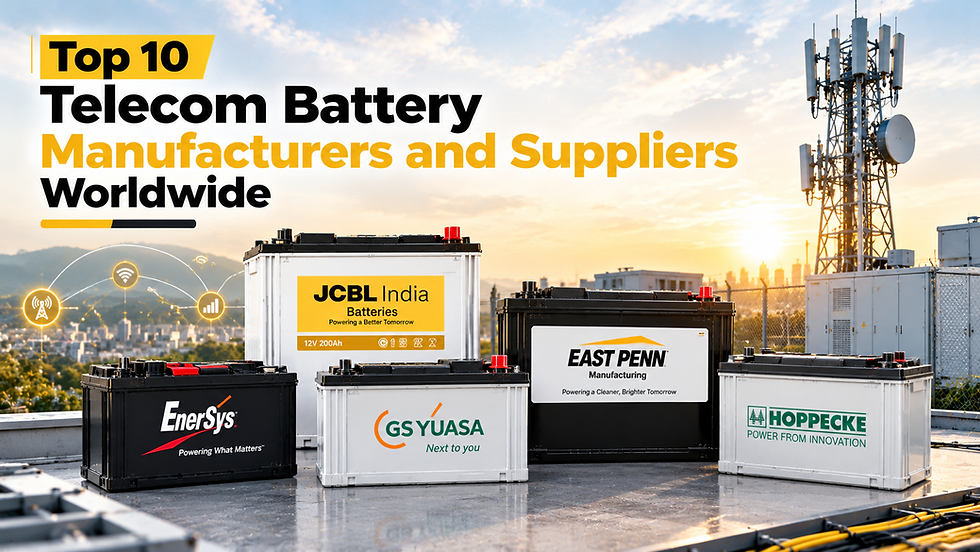
From established industrial battery manufacturers to companies offering advanced lithium-ion energy storage solutions, the global market provides options for different network requirements. Here are ten telecom battery manufacturers and suppliers worth considering for telecom operators, infrastructure companies, distributors, and international buyers.
Different Types of Telecom Batteries
Note: Actual performance, service life, and suitability vary by product model, site temperature, discharge profile, and charging configuration. Confirm manufacturer specifications before selecting a battery.
Battery type | Key advantages | Limitations | Common telecom applications |
Low maintenance, sealed design, good power delivery | Sensitive to high temperatures; service life can shorten with deep cycling | BTS sites, telecom cabinets, indoor backup | |
Sealed construction, good performance in suitable cycling applications | Charging requirements must be controlled; typically higher initial cost than some AGM options | Remote telecom sites and stationary backup | |
Established technology, often lower initial cost | Requires maintenance, ventilation, and spill precautions | Selected telecom facilities with suitable battery rooms | |
Long cycle life, lower weight, high usable capacity | Higher initial investment; requires compatible battery management and charging systems | Outdoor towers, remote sites, compact backup systems | |
Nickel-cadmium (Ni-Cd) | Robust construction and tolerance of demanding environments in suitable designs | Higher cost, lower energy density, and environmental considerations associated with cadmium | Specialized industrial and critical infrastructure installations |
To help you compare available options, we have compiled a list of 10 telecom battery manufacturers and suppliers worldwide. This list highlights their country of origin, key specializations, and relevant strengths to help you identify potential suppliers for your telecom backup power requirements.
1. JCBL India Batteries – India
JCBL India Batteries is an India-based battery supplier and exporter offering solutions across backup applications, industrial power, automotive batteries, and lithium-ion energy storage. Its broad product portfolio makes it a company worth considering for businesses exploring battery sourcing options for backup-power applications.
For telecom infrastructure, battery selection must match the equipment's power requirements, required backup duration, charging arrangements, and installation environment. JCBL's backup battery portfolio and lithium-ion offerings provide buyers with options to explore for suitable standby and energy-storage requirements.
Key Highlights
Country: India
Product categories: Backup application batteries, industrial batteries, and lithium-ion solutions
Potential applications: Standby power and selected telecom backup installations, subject to product specifications
Business strengths: International supply experience and a broad battery portfolio
Customer segments: Importers, distributors, wholesalers, and business buyers
One advantage of considering JCBL India Batteries is the opportunity to explore different battery categories through one supplier. Its lithium-ion portfolio includes LiFePO₄-based solutions, which may be relevant for installations seeking long cycle life and reduced battery weight. However, buyers should verify the exact model, capacity, discharge performance, and telecom-specific suitability before procurement.
JCBL also serves international markets across Southeast Asia, the Middle East, Africa, Europe, South America, and the USA. This export experience can be relevant to distributors and telecom equipment suppliers seeking an India-based battery sourcing partner.
Businesses can explore the company's battery products and solutions and discuss their specific requirements before making a purchasing decision.
Best suited for: Importers, distributors, and businesses seeking a supplier with multiple battery categories and international supply capabilities.
2. EnerSys – United States
EnerSys is a well-established global provider of stored-energy solutions for industrial and critical-power applications. Its portfolio serves sectors where dependable backup power is important, including telecommunications, data centres, utilities, and industrial infrastructure.
The company's reserve-power expertise makes it a relevant choice for telecom operators and infrastructure providers managing demanding backup-power requirements. Depending on the installation, battery selection may involve conventional lead-acid technology or advanced energy-storage solutions.
Key highlights:
Country: United States
Specialization: Industrial batteries and reserve power
Applications: Telecommunications, UPS systems, data centres, and utilities
Key strength: Experience in critical-power applications
EnerSys is particularly worth evaluating for large-scale telecom projects where battery performance, technical support, and compatibility with existing power infrastructure are important.
3. Exide Industries – India
Exide Industries is one of India's established battery manufacturers, with a substantial presence in automotive and industrial battery markets. Its infrastructure battery portfolio includes solutions specifically designed for telecommunications applications.
The company's telecom offerings include valve-regulated lead-acid (VRLA) batteries using absorbed glass mat (AGM) and tubular gel technologies. These batteries are designed for standby applications in which maintenance requirements, backup duration, and dependable performance are important considerations.
Key highlights:
Country: India
Specialization: Industrial and infrastructure batteries
Technologies: VRLA AGM and tubular gel
Applications: Telecom networks, UPS systems, and infrastructure
Key strength: Dedicated telecom battery products and manufacturing experience
Exide is a relevant option for telecom operators and distributors seeking established lead-acid battery technologies, including products for stationary backup installations.
4. Amara Raja Energy & Mobility – India
Amara Raja Energy & Mobility is an Indian energy-storage company known for its battery manufacturing expertise and established presence in automotive and industrial markets. Its experience across battery technologies makes it relevant to businesses evaluating backup-power suppliers.
Telecom battery requirements can differ substantially from automotive applications, particularly where batteries must remain on float charge for extended periods or undergo frequent discharge cycles.
Buyers should therefore assess the company's specific stationary-power offerings rather than relying solely on its automotive portfolio.
5. GS Yuasa – Japan
GS Yuasa is a Japanese battery manufacturer with extensive experience in industrial and stationary battery systems. Its products serve a range of applications requiring dependable stored energy, including telecommunications, emergency power, and industrial backup.
The company works with established battery technologies and develops solutions for different operating environments. Depending on the system design, telecom buyers may consider its stationary batteries for communication facilities, switching centres, and other installations requiring standby power.
Key highlights:
Country: Japan
Specialization: Industrial and stationary batteries
Technologies: Lead-acid and lithium-ion, depending on product range
Applications: Telecommunications, emergency backup, and industrial power
Key strength: Battery engineering expertise and an established international presence
GS Yuasa is worth evaluating when technical reliability, product documentation, and compatibility with existing power systems are central purchasing considerations.
6. East Penn Manufacturing – United States
East Penn Manufacturing is an established American battery manufacturer with extensive expertise in lead-acid battery technology. Its product range covers automotive, commercial, industrial, and stationary power applications.
The company offers battery technologies including absorbed glass mat (AGM) and gel, depending on the product line. These technologies are used in different standby and energy-storage applications, although telecom buyers should verify the suitability of individual models for their intended duty cycle.
7. HOPPECKE – Germany
HOPPECKE specializes in industrial battery systems and energy-storage solutions for applications such as telecommunications, railways, data centres, and renewable energy installations.
Telecom networks often require battery systems that can provide dependable backup while operating within space, ventilation, and temperature constraints. HOPPECKE's industrial focus makes it relevant to projects where battery configuration and installation requirements need careful technical evaluation.
8. FIAMM Energy Technology – Italy
FIAMM Energy Technology is an Italian battery supplier serving industrial, automotive, and standby-power markets. Its portfolio includes solutions for applications where backup energy is essential to maintaining operational continuity.
Telecommunications infrastructure is one of the areas in which stationary battery systems are important. Buyers considering FIAMM should assess its relevant standby battery products according to required autonomy, discharge characteristics, and installation conditions.
Key highlights:
Country: Italy
Specialization: Industrial and standby batteries
Applications: Telecommunications, UPS systems, and industrial backup
Key strength: Experience across multiple battery applications
FIAMM can be included in supplier evaluations where businesses want to compare established industrial battery manufacturers and their backup-power offerings.
9. Leoch International – China
Leoch International is a battery manufacturer with an extensive portfolio serving standby power, industrial, motive-power, and other energy-storage markets. Its manufacturing and distribution activities make it relevant to international buyers sourcing batteries for different commercial applications.
Telecom backup systems may use VRLA batteries or lithium-based alternatives depending on network design, operating conditions, and investment priorities. Leoch's range of battery technologies provides buyers with options to investigate for suitable installations.
10. Saft – France
Saft is a battery technology company specializing in advanced battery solutions for industrial, transportation, and infrastructure applications. Its expertise in industrial energy storage and lithium-based technologies makes it relevant to projects with demanding technical requirements.
Telecom operators increasingly evaluate advanced battery systems for installations where space efficiency, monitoring, and operational performance matter. The suitability of a particular Saft solution will depend on the project's voltage, power demand, backup duration, and environmental conditions.
Key highlights:
Country: France
Specialization: Advanced industrial battery technologies
Technologies: Lithium-based and other industrial battery solutions
Applications: Infrastructure, industrial power, and selected critical-power systems
Key strength: Advanced battery engineering and application-specific solutions
How to Choose the Right Telecom Battery Manufacturer
Selecting a telecom battery supplier involves more than comparing prices or advertised capacities. The battery must meet the network's actual backup requirements and operate reliably under site-specific conditions.
1. Choose the Appropriate Battery Technology
VRLA AGM batteries are commonly used for stationary backup because they are sealed and require relatively little routine maintenance. Tubular gel batteries can be appropriate for certain operating conditions, while lithium iron phosphate (LiFePO₄) batteries may offer advantages in cycle life, weight, and usable energy. The correct choice depends on the application and total cost of ownership.
2. Calculate Backup Capacity Correctly
Consider the connected load, required backup duration, discharge rate, inverter or rectifier efficiency, temperature, and allowable depth of discharge. Battery capacity should be calculated using the actual operating profile rather than nominal ampere-hour ratings alone.
3. Evaluate Temperature and Installation Conditions
Outdoor telecom sites may experience high temperatures, dust, humidity, and limited ventilation. Confirm the manufacturer's operating-temperature limits and the battery's expected performance under the conditions at the installation site.
4. Check Quality, Safety, and Compliance
Request technical datasheets, test reports, applicable certifications, warranty terms, and installation guidance. Where relevant, verify compliance with telecom operator specifications and applicable national requirements.
5. Assess Supply and After-Sales Support
For large networks and international distribution, consistent availability, replacement planning, shipping arrangements, and technical assistance can be as important as the initial purchase price.
Conclusion
The global telecom battery market includes manufacturers with different strengths, ranging from established VRLA battery suppliers to companies specializing in advanced industrial energy storage. EnerSys, Exide Industries, GS Yuasa, HOPPECKE, and other manufacturers offer options worth evaluating according to project requirements.
JCBL India Batteries is also worth considering for buyers seeking an India-based supplier with a broad battery portfolio, backup-power products, lithium-ion solutions, and international supply experience. Its suitability for a specific telecom installation should be established through model-level specifications and application requirements.
Ultimately, the right supplier is one that combines appropriate battery technology, dependable performance, verified quality, competitive lifetime costs, and reliable supply. Comparing these factors helps telecom operators, infrastructure providers, and distributors make informed procurement decisions.
Frequently Asked Questions
1. Which are the top telecom battery manufacturers and suppliers worldwide?
Some well-known telecom battery manufacturers and suppliers include JCBL India Batteries, EnerSys, Exide Industries, Amara Raja Energy & Mobility, GS Yuasa, East Penn Manufacturing, HOPPECKE, FIAMM Energy Technology, Leoch International, and Saft. The right choice depends on battery technology, backup requirements, operating conditions, and supplier capabilities.
2. Which type of battery is best for telecom towers?
The best battery for a telecom tower depends on its power demand, required backup duration, site conditions, and maintenance requirements. VRLA AGM and gel batteries are commonly used for stationary backup, while lithium iron phosphate (LiFePO₄) batteries may be suitable for installations requiring longer cycle life, lower weight, and efficient energy storage.
3. What are the different types of telecom batteries?
The main types of telecom batteries include VRLA AGM, VRLA gel, flooded lead-acid, lithium iron phosphate (LiFePO₄), and other lithium-ion batteries. Each technology offers different benefits in terms of cost, maintenance, service life, weight, and operating conditions.
4. How long do telecom backup batteries last?
Telecom battery life varies according to battery chemistry, product design, temperature, charging practices, discharge frequency, and maintenance. Some lead-acid batteries may require replacement after a few years, while appropriately selected lithium-ion batteries can offer longer cycle life. Actual service life should be assessed using the manufacturer's specifications and site operating conditions.
5. Why are lithium-ion batteries used in telecom backup systems?
Lithium-ion batteries, particularly LiFePO₄ models, can offer high usable energy, lower weight, compact installation, and long cycle life. They may also support battery monitoring and management systems. Their suitability depends on system compatibility, operating temperature, safety provisions, and the project's total cost of ownership.
6. What should buyers consider when selecting a telecom battery supplier?
Buyers should evaluate battery capacity, backup duration, battery chemistry, discharge performance, operating temperature, warranty, quality certifications, technical documentation, product availability, and after-sales support. Compatibility with existing rectifiers, chargers, and battery management systems is also important.


Comments