

Top 10 Backup Power Battery Suppliers Worldwide


Choosing the right backup battery supplier can help businesses reduce downtime, protect profit margins, and build lasting customer trust. But with manufacturers offering different battery technologies, product quality, and supply capabilities, finding the right partner is not always straightforward.
So, which manufacturers are worth considering for your business?
In this guide, we explore 10 backup battery manufacturers and suppliers worldwide, comparing their key products, applications, and strengths to help importers, distributors, and industrial buyers make informed sourcing decisions.
Quick Comparison: 10 Backup Battery Manufacturers and Suppliers
The following overview provides a starting point for buyers comparing suppliers across different backup power applications.
Manufacturer | Country | Key applications to explore |
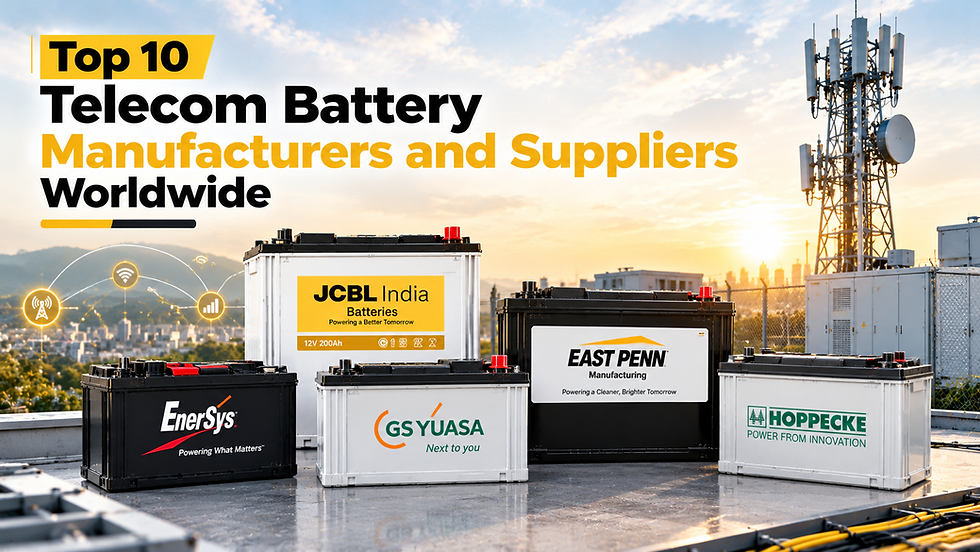
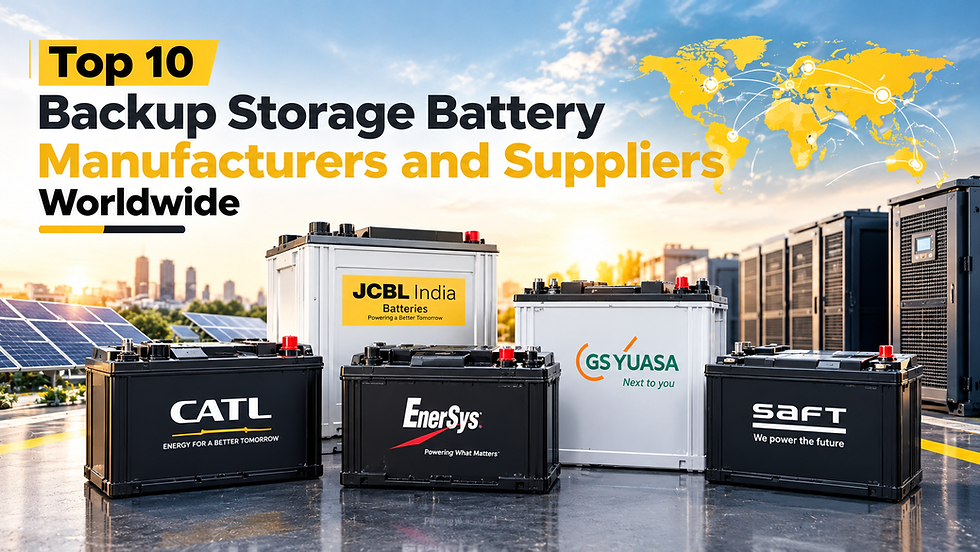
JCBL India Batteries | India | Backup, inverter, industrial and lithium-based batteries |
EnerSys | United States | Industrial UPS and critical-power systems |
GS Yuasa | Japan | Stationary batteries and industrial standby power |
Exide Industries | India | Industrial, telecom and UPS applications |
Amara Raja Energy & Mobility | India | Industrial batteries and backup power |
East Penn Manufacturing | United States | Lead-acid, AGM and stationary batteries |
HOPPECKE | Germany | Industrial battery systems and infrastructure |
Saft | France | Advanced batteries and specialized energy storage |
FIAMM Energy Technology | Italy | Telecom and standby power |
Leoch International | China | VRLA, lead-acid and lithium battery solutions |
This is a selection of manufacturers and suppliers to consider, not a definitive ranking based on independently verified performance.
1. JCBL India Batteries – India
Backup battery solutions for diverse power requirements
JCBL India Batteries is an Indian battery supplier offering products across backup applications, industrial batteries, and lithium-ion energy storage. Its published product categories include sealed maintenance-free valve-regulated lead-acid (SMF-VRLA) batteries, tubular inverter and solar batteries, and lithium-ion solutions for selected applications.
For buyers looking to source different battery categories, the company is worth considering when comparing conventional lead-acid technologies with newer energy-storage options.
Key product categories
SMF-VRLA batteries for compatible UPS and standby applications
Tubular batteries for inverter and selected solar applications
Lithium-ion and lithium iron phosphate (LiFePO₄) solutions for compatible energy-storage requirements
Wide temperature range Industrial batteries for selected backup and power applications
Why consider this supplier?
The breadth of its published battery categories gives distributors, wholesalers, and commercial buyers several product segments to investigate. Businesses interested in bulk procurement can also discuss model availability, technical specifications, order quantities, export documentation, and commercial terms directly with the company.
Best suited for: Battery distributors, importers, inverter businesses, solar suppliers, and industrial buyers seeking to evaluate multiple battery technologies.
Explore the JCBL India Batteries website and its backup application battery range for product details.
2. EnerSys – United States
Industrial power and critical backup applications
EnerSys is a global stored-energy solutions provider serving industrial and specialty markets. Its reserve-power products are used in applications where dependable backup electricity is important, including telecommunications, data centres, utilities, and uninterruptible power supply systems.
The company offers a range of battery technologies designed for different operating environments and power requirements.
Key areas to explore
Industrial UPS batteries
Telecommunications reserve-power systems
Stationary battery configurations
Critical-power applications for commercial and industrial facilities
Why consider it?
EnerSys is relevant to buyers seeking established industrial battery products and related power solutions for demanding applications.
Best suited for: Data-centre operators, telecom companies, infrastructure contractors, and industrial procurement teams.
3. GS Yuasa – Japan
Stationary batteries for industrial and infrastructure requirements
GS Yuasa is a Japanese battery manufacturer with products spanning automotive, industrial, and energy-storage markets. Its industrial battery business serves applications including UPS systems, telecommunications, emergency power, and infrastructure.
Its portfolio includes lead-acid and lithium-ion technologies for different requirements.
Key areas to explore
Stationary and standby batteries
Industrial UPS applications
Telecommunications backup
Infrastructure and energy-storage solutions
Why consider it?
GS Yuasa is worth evaluating for its experience across industrial battery categories and established presence in multiple markets.
Best suited for: Infrastructure operators, industrial facilities, telecom businesses, and buyers seeking stationary battery solutions.
4. Exide Industries – India
A well-established supplier of industrial battery products
Exide Industries has a long-standing presence in India's battery industry. Its portfolio serves automotive and industrial markets, including applications involving UPS systems, telecommunications, utilities, and other infrastructure.
The company's industrial offerings include different lead-acid technologies, such as VRLA and tubular batteries.
Key areas to explore
Industrial backup batteries
UPS and telecommunications batteries
Tubular battery solutions
Power systems for infrastructure applications
Why consider it?
Its established manufacturing background and broad battery portfolio make it a relevant option for buyers comparing conventional backup battery technologies.
Best suited for: Industrial buyers, infrastructure projects, distributors, and businesses evaluating established lead-acid suppliers.
5. Amara Raja Energy & Mobility – India
Industrial batteries and evolving energy-storage technologies
Amara Raja Energy & Mobility serves automotive, industrial, and energy-related markets. Its industrial battery activities include products for telecommunications, UPS systems, railways, and other applications that depend on reliable stored power.
The company also has interests in developing advanced battery and energy-storage technologies.
Key areas to explore
Industrial lead-acid batteries
UPS and telecommunications applications
Stationary backup power
Advanced energy-storage technologies where commercially available
Why consider it?
Its battery manufacturing experience and presence across industrial markets make it a useful candidate for supplier comparisons.
Best suited for: Industrial distributors, telecom suppliers, infrastructure businesses, and procurement teams evaluating established and emerging battery technologies.
6. East Penn Manufacturing – United States
Lead-acid and stationary battery expertise
East Penn Manufacturing is an American battery manufacturer known for its extensive lead-acid battery portfolio. Through its Deka brand and other product lines, the company serves automotive, industrial, motive-power, and stationary-power markets.
Its offerings include AGM and gel batteries alongside other lead-acid configurations.
Key areas to explore
AGM and gel batteries
Stationary backup applications
Industrial and commercial power
Telecommunications and renewable-energy installations
Why consider it?
East Penn is relevant for buyers seeking established lead-acid technologies and a broad selection of batteries for industrial applications.
Best suited for: Battery distributors, commercial power buyers, and organizations evaluating lead-acid backup systems.
7. HOPPECKE – Germany
Battery systems for demanding industrial environments
HOPPECKE specializes in industrial energy storage and battery systems. Its portfolio addresses stationary power, telecommunications, UPS installations, railways, and renewable-energy applications.
The company offers multiple battery technologies and solutions designed around industrial operating requirements.
Key areas to explore
Industrial stationary batteries
UPS and telecommunications backup
Railway and infrastructure battery systems
Renewable-energy storage
Why consider it?
HOPPECKE is particularly relevant for projects that require industrial battery systems selected according to the installation's operating conditions.
Best suited for: Engineering contractors, industrial facilities, infrastructure operators, and system integrators.
8. Saft – France
Advanced battery solutions for specialized applications
Saft is a French battery manufacturer specializing in advanced battery technologies for industrial and specialized markets. Its activities include energy storage, transportation, telecommunications, and critical infrastructure.
Its lithium-ion and other advanced battery products serve applications with specific operating and engineering requirements.
Key areas to explore
Advanced lithium-ion batteries
Industrial energy storage
Renewable-energy integration
Specialized infrastructure and critical-power applications
Why consider it?
Saft is worth investigating for engineered projects where battery performance, system design, and application-specific requirements are central to the procurement decision.
Best suited for: Infrastructure developers, industrial engineering teams, and buyers with specialized energy-storage needs.
9. FIAMM Energy Technology – Italy
Standby power and telecommunications batteries
FIAMM Energy Technology serves industrial and energy-storage markets with batteries for applications requiring dependable standby power. Its portfolio includes products for telecommunications, UPS systems, utilities, and industrial installations.
Key areas to explore
Standby power batteries
UPS applications
Telecommunications backup
Industrial and utility installations
Why consider it?
FIAMM is an option for buyers comparing manufacturers with experience in stationary batteries and conventional backup power systems.
Best suited for: Telecom suppliers, industrial procurement teams, and infrastructure businesses.
10. Leoch International – China
Multiple battery categories for global markets
Leoch International is a battery manufacturer offering lead-acid and lithium-based products for applications including telecommunications, UPS systems, motive power, and energy storage.
Its broad product categories make it relevant to buyers comparing suppliers across several battery segments.
Key areas to explore
VRLA and AGM batteries
Industrial standby power
Telecommunications and UPS applications
Selected lithium-based battery products
Why consider it?
Leoch is worth evaluating for its range of battery categories and presence in international markets. Buyers should assess individual models against their technical and commercial requirements.
Best suited for: Importers, distributors, telecom equipment suppliers, and industrial battery buyers.
Understanding the Main Types of Backup Batteries
Choosing the right manufacturer is only part of the process. The battery technology must also match the application, charging system, operating environment, and expected backup duration.
1. SMF-VRLA batteries
Sealed maintenance-free valve-regulated batteries are widely used in compatible UPS systems, emergency lighting, security equipment, and standby applications.
AGM batteries are one common type of VRLA battery. Their construction reduces routine maintenance compared with conventional flooded batteries, although proper charging, ventilation, and installation remain important.
Typical applications: UPS systems, emergency backup, security equipment, and standby power.
2. Tubular lead-acid batteries
Tubular batteries are widely used in inverter and solar applications where batteries may undergo regular charging and discharging.
The suitability of a model depends on its design, rated capacity, cycle requirements, and charging arrangement.
Typical applications: Residential inverters, commercial backup systems, and compatible solar installations.
3. Lithium-ion and LiFePO₄ batteries
Lithium-ion batteries are increasingly used in backup power and energy storage. LiFePO₄ chemistry is valued for thermal stability and cycle-life characteristics when operated within the manufacturer's specifications.
Depending on the system, lithium batteries may provide lower weight and higher usable energy. However, buyers must consider upfront cost, battery management systems, charging compatibility, and installation requirements.
Typical applications: Solar energy storage, systems with frequent cycling, and space-conscious installations.
4. Industrial stationary batteries
Industrial stationary batteries are designed for specific power requirements and may need to meet demanding discharge, monitoring, service-life, and maintenance criteria.
Typical applications: Data centres, telecommunications networks, utilities, and industrial infrastructure.
Which Backup Battery Is Suitable for Your Application?
Application | Battery types to investigate | Main consideration |
Home inverter | Tubular lead-acid or compatible lithium | Backup duration and cycle life |
Office UPS | SMF-VRLA/AGM or compatible lithium | Runtime and load profile |
Telecom infrastructure | Industrial VRLA or specified lithium | Reliability and operating temperature |
Data centre | Purpose-designed stationary batteries | Discharge performance and system reliability |
Solar energy storage | Tubular or compatible LiFePO₄ | Daily cycling and usable capacity |
Industrial facilities | Application-specific stationary batteries | Discharge profile and service requirements |
These recommendations are starting points rather than universal prescriptions. Always check the equipment manufacturer's requirements and the battery supplier's technical documentation.
How to Select a Reliable Backup Battery Supplier
For importers, distributors, and industrial buyers, the right supplier should meet technical requirements while supporting reliable procurement over time.
Use this checklist when comparing quotations.
Technical specifications: Verify voltage, rated capacity, dimensions, terminals, discharge ratings, and compatibility.
Operating conditions: Confirm permitted temperature, ventilation, charging conditions, and installation requirements.
Battery duty cycle: Establish whether the battery will remain on standby or undergo frequent cycling.
Quality documentation: Request applicable test reports, certificates, traceability records, and warranty terms.
Supply capability: Review availability, production lead times, minimum order quantities, and shipping arrangements.
Customization: Ask about OEM branding, private-label packaging, and application-specific configurations if needed.
Total cost of ownership: Consider expected service life, maintenance, efficiency, and replacement costs alongside the purchase price.
After-sales support: Clarify technical assistance, warranty claims, and procedures for handling product issues.
Export compliance: Confirm applicable packaging, transport, labelling, and destination-market requirements.
A well-informed procurement decision reduces the risk of selecting a battery that appears cost-effective initially but proves unsuitable for the intended application.
Final Thoughts
The global backup battery market offers a diverse selection of manufacturers, each with different areas of specialization. EnerSys, GS Yuasa, and HOPPECKE are worth exploring for industrial and critical-power requirements, while East Penn Manufacturing, FIAMM Energy Technology, and Leoch International provide additional options across stationary and backup battery categories. Indian manufacturers such as JCBL India Batteries, Exide Industries and Amara Raja Energy & Mobility are also relevant to buyers evaluating suppliers in India.
Battery selection also depends on the environment in which the product will operate. For businesses sourcing batteries for applications with varying temperature conditions, working with a wide temp range battery distributor can help simplify the process of identifying suitable options. Buyers should review the operating temperature limits of individual models to ensure they align with the demands of the intended application.
Ultimately, the best backup battery supplier is not necessarily the largest manufacturer or the one offering the lowest price. It is the supplier whose products match the application, whose quality can be verified, and whose supply and support arrangements meet long-term operational needs.
Frequently Asked Questions
1. Who are the top backup battery manufacturers worldwide?
Notable manufacturers and suppliers to investigate include JCBL India Batteries, EnerSys, GS Yuasa, Exide Industries, Amara Raja Energy & Mobility, East Penn Manufacturing, HOPPECKE, Saft, FIAMM Energy Technology, and Leoch International.
2. Which battery is best for backup power?
The best choice depends on the application. SMF-VRLA batteries are commonly used in compatible UPS systems, tubular batteries are widely used for inverter backup, and LiFePO₄ batteries may suit energy-storage systems requiring frequent cycling.
3. Which manufacturers supply industrial UPS batteries?
JCBL India Batteries, EnerSys, GS Yuasa, Exide Industries, Amara Raja Energy & Mobility, HOPPECKE, and other industrial battery manufacturers offer products for relevant UPS or stationary-power applications. Confirm individual product specifications before purchasing.
4. Are lithium batteries better than lead-acid batteries for backup?
Not in every situation. Lithium batteries can offer lower weight and strong cycle-life performance, while lead-acid batteries may be suitable when initial cost, existing equipment, and standby operating requirements favor that technology. Compare usable capacity, service life, charging requirements, and total cost.
5. What should buyers check before ordering backup batteries in bulk?
Review the exact model, capacity, discharge ratings, dimensions, technical documentation, warranty, minimum order quantity, production lead time, export requirements, and after-sales support.
6. How can I find a backup battery supplier in India?
Start by comparing manufacturers based on the required battery technology, application, certifications, supply capability, and export experience. JCBL India Batteries is one option to investigate alongside other established Indian manufacturers.

Comments