.png)

Understanding JIS and DIN: Automotive Battery Standards

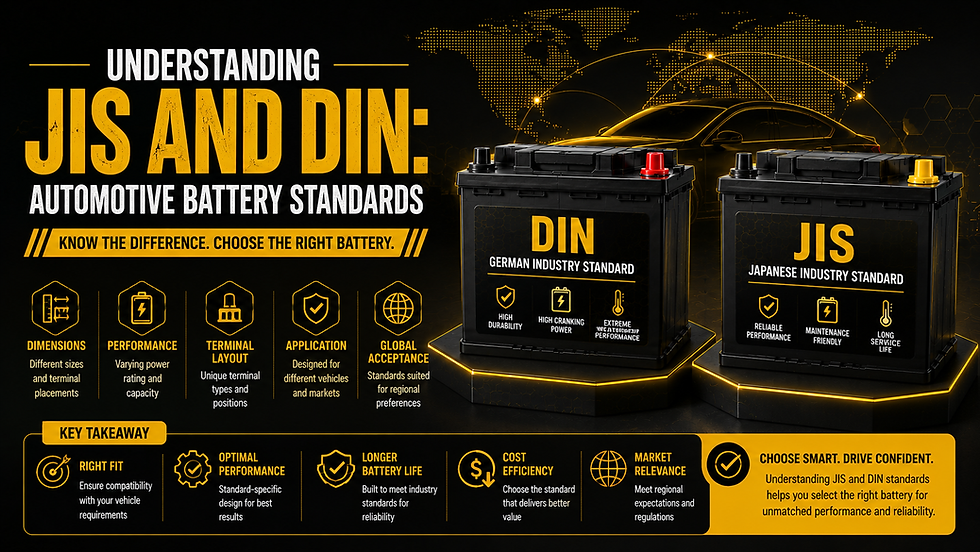
Automotive battery standards provide a framework for identifying and specifying batteries according to their physical and electrical requirements. For international automotive battery sourcing, two of the most commonly encountered standards are JIS and DIN, associated primarily with Japanese and European vehicle applications.
But what is a JIS battery standard? What does a DIN battery specification mean? And how can an importer, distributor, fleet operator or project buyer determine which battery is right for a particular application?
This guide explains automotive battery standards, with a specific focus on JIS and DIN batteries. It covers how these standards identify battery requirements, the key differences between JIS and DIN, what buyers should check before ordering, and how an experienced supplier can help match battery specifications to project requirements.
What Are Automotive Battery Standards?
Automotive battery standards are specifications used to identify and define important characteristics of vehicle starter batteries, including dimensions, terminals, polarity and performance requirements.
Standardisation allows vehicle manufacturers, battery manufacturers, distributors and buyers to communicate battery requirements more consistently.
A battery's voltage alone does not determine compatibility. Two 12V batteries may have different:
Dimensions
Terminal positions
Terminal types
Polarity
Capacity
Starting performance
Mounting configurations
Applicable testing requirements
This is why automotive battery standards become particularly important when replacing batteries across different vehicle models or sourcing them internationally in bulk.
JIS and DIN Automotive Battery Standards at a Glance
Factor | JIS | DIN / European Format |
Origin | Japan | Germany / European standards framework |
Common association | Japanese and Asian vehicles | European vehicles |
Identification | JIS battery coding system | DIN/EN-based specifications and formats |
Key parameters | Performance rank, dimensions, length and polarity | Dimensions, terminals, marking and performance |
Typical sourcing requirement | Match complete JIS specification | Confirm applicable DIN/EN specification |
Selection principle | Match vehicle and application | Match vehicle and application |
Quick insight: JIS and DIN should not be treated as battery technologies. They are standardisation references used to identify and specify automotive batteries. The correct battery depends on the vehicle and application's complete requirements.
What Is the JIS Battery Standard?
JIS stands for Japanese Industrial Standards. JIS D 5301 is the Japanese standard associated with lead-acid starting batteries.
JIS batteries are widely used in Japanese vehicles and are also common across many Asian automotive applications.
One of the most useful features of the JIS system is its battery identification code. Rather than being simply a model number, the designation communicates important information about the battery's performance and physical configuration.
The Battery Association of Japan explains that the JIS designation identifies four main characteristics:
Performance rank — indicates overall performance based on starting performance and capacity-related characteristics.
Width and box height — represented by a letter corresponding to defined JIS size categories.
Approximate battery length — represented by a number corresponding approximately to the battery's length in centimetres.
Polarity position — identifies the polarity arrangement.
How Do You Read a JIS Battery Code?
A JIS battery code provides a quick reference to the battery's performance rank, size and polarity.
For example, 55B24R can be understood as:
55 – JIS performance rank, not 55 Ah
B – battery width and height category
24 – approximate battery length in centimetres
R – polarity position
So, 55B24R identifies a battery by its performance category, physical size and polarity arrangement. However, buyers should still verify the complete specification, including exact dimensions, terminals and electrical requirements, before ordering.
What Is the DIN Battery Standard?
DIN refers to the Deutsches Institut für Normung, Germany's national standards organisation. In the automotive battery market, “DIN battery” commonly describes German or European-style battery formats.
There is an important distinction for international buyers: modern European automotive battery requirements are not necessarily governed by one single DIN document.
European requirements are also covered through EN standards. For example, DIN EN 50342-2:2021-01, the German adoption of EN 50342-2:2019, covers dimensions of lead-acid starter batteries and terminal marking for 12V starter batteries used in passenger cars and light commercial vehicles.
Therefore, when a buyer asks for a “DIN battery,” the supplier should confirm the actual applicable DIN/EN specification and vehicle requirement.
What Information Should You Check for a DIN Battery?
Depending on the application, buyers may need to confirm:
Battery length, width and height
Terminal arrangement
Terminal marking
Polarity
Capacity
Starting performance
Mounting configuration
Applicable DIN/EN requirements
Quick insight: “DIN battery” is useful market terminology, but the complete technical specification matters more than the label itself.
What Is the Difference Between JIS and DIN Batteries?
The main difference between JIS and DIN batteries is the standardisation system used to identify their specifications and the vehicle markets with which they are commonly associated.
JIS batteries use a distinctive identification system that communicates performance and physical characteristics through a defined code.
DIN terminology is commonly associated with German and European battery formats, while current European requirements may be specified through applicable EN standards.
Specification | JIS Battery | DIN / European Battery |
Main market association | Japan and Asia | Europe |
Identification approach | JIS coding system | DIN/EN-based specification |
Size identification | Encoded within JIS designation | Defined through applicable specification |
Polarity | Included in JIS identification | Confirmed through applicable specification |
Procurement approach | Match complete JIS specification | Match complete DIN/EN specification |
Important: A JIS battery should not automatically be substituted with a DIN-format battery simply because both have the same voltage or similar capacity. The complete physical and electrical specification must be compatible.
How Do JIS and DIN Battery Specifications Affect Battery Selection?
JIS and DIN battery specifications help identify the physical and electrical characteristics that determine whether a battery is suitable for a particular vehicle. These can include dimensions, terminal configuration, polarity and required performance.
Understanding these specifications is important because two batteries with the same voltage or similar capacity may still have different physical configurations and may not be interchangeable.
Battery specification | Why it matters |
Dimensions | Determines whether the battery fits the vehicle's battery tray and available space. |
Terminal configuration | Determines whether the battery can connect correctly to the vehicle's cables. |
Polarity | Ensures the positive and negative terminals correspond with the vehicle's electrical configuration. |
Performance | Helps establish whether the battery can meet the vehicle's starting and electrical requirements. |
Mounting configuration | Ensures the battery can be securely installed in its intended position. |
For JIS batteries, several of these characteristics are reflected in the JIS identification system. For example, the JIS code communicates information about performance rank, case dimensions, approximate length and polarity.
For DIN and European-format batteries, dimensions, terminal marking and other applicable specifications are established through the relevant DIN/EN requirements and the vehicle's technical requirements.
The key takeaway: JIS and DIN should be evaluated using the complete battery specification—not simply voltage, capacity or a familiar battery size. Matching the complete specification is what helps ensure physical fit, correct connection and appropriate performance.
How Should You Choose a JIS or DIN Battery for a Project?
The right JIS or DIN battery is the one whose complete specification matches the vehicle, equipment or project's technical requirements.
For a single replacement, the existing battery and vehicle manufacturer's specification are useful starting points.
For commercial procurement, however, buyers should establish the requirement systematically.
1. Define the application
Identify the vehicle models, engine requirements, operating conditions and intended use.
2. Establish the required standard
Determine whether the project requires a JIS specification or a DIN/EN-based European
specification.
3. Confirm the physical specification
Check dimensions, terminals, polarity and mounting configuration.
4. Confirm electrical requirements
Review voltage, capacity, starting performance and any other application-specific parameters.
5. Define quantities and product range
A distributor or fleet project may require several battery specifications across different vehicle models.
6. Document the agreed specification
For bulk, OEM, private-label or repeat orders, the final technical specification should be confirmed with the supplier before production and shipment.
What Information Should You Give a Battery Supplier?
For faster and more accurate product selection, an importer or project buyer should ideally provide:
Information | Example Requirement |
Vehicle/application | Passenger car, commercial vehicle, fleet |
Standard | JIS or DIN/EN |
Existing battery | Current battery code/model |
Dimensions | Length × width × height |
Electrical requirement | Voltage, capacity, starting performance |
Terminal arrangement | Position and type |
Quantity | Trial, monthly or annual requirement |
Market | Destination country/region |
Commercial requirement | OEM, replacement, distributor or private label |
Buyer insight: The more precisely the application is defined, the easier it is for a supplier to recommend the appropriate battery specification.
How Can JCBL India Batteries Support Project-Based Battery Sourcing?
JCBL India Batteries can support international buyers not only with battery selection, but also with the broader requirements of project-based sourcing.
Depending on the project, this may include:
Product matching: Reviewing the buyer's defined technical requirements and identifying suitable battery specifications.
Multi-specification projects: Supporting projects that require different battery sizes or specifications for multiple vehicle or equipment applications.
Bulk and commercial supply: Coordinating requirements for trial orders, recurring purchases and larger-volume procurement.
OEM and private-label requirements: Supporting projects where batteries are required under a buyer's own brand or specific commercial arrangement.
Packaging and export requirements: Coordinating product and packaging requirements according to the destination market and order specifications.
Repeat-order consistency: Maintaining the agreed product specification across recurring orders to support more predictable procurement.
Supply planning: Working with buyers to establish a practical supply program based on project volumes and purchasing requirements.
This approach is particularly useful when a buyer needs more than a single replacement battery and instead requires a coordinated range of products from one supply partner.
The goal is simple: understand the project, match the right products, and build a dependable supply program around the buyer's requirements.
What Should You Ask an Automotive Battery Supplier?
Before placing a bulk or international order, buyers should clarify:
Supplier Question | Why It Matters |
Which standard does the battery follow? | Establishes the technical basis |
What are the exact dimensions? | Confirms physical compatibility |
Where are the terminals positioned? | Prevents installation issues |
What is the polarity configuration? | Ensures correct connection |
What are the capacity and starting specifications? | Confirms performance |
What testing or certification applies? | Supports project and market requirements |
Can the same specification be maintained? | Important for repeat orders |
Can the supplier support the required volume and market? | Helps assess long-term sourcing capability |
A supplier that can answer these questions clearly gives buyers greater confidence in both product selection and long-term procurement.
Key Takeaways
JIS and DIN are important references for identifying and specifying automotive starter batteries across different vehicle markets.
JIS D 5301 provides the framework associated with Japanese lead-acid starting batteries, including a coding system that communicates performance rank, physical dimensions, approximate length and polarity.
DIN terminology is commonly used for German and European battery formats, while current European requirements may also be defined through EN standards such as EN 50342-2, which addresses dimensions and terminal marking.
For buyers, the most important principle is:
Do not select an automotive battery based on voltage or capacity alone. Match the complete specification to the application.
That means considering the standard, dimensions, terminals, polarity, electrical performance, vehicle requirements, project quantity and target market together.
For international buyers sourcing JIS and DIN automotive batteries from India, JCBL India’s Batteries can be evaluated according to the specific requirements of the vehicle, project and destination market.
Frequently Asked Questions
1. What are JIS and DIN automotive battery standards?
JIS and DIN are standardisation references used to identify and specify automotive batteries, including characteristics such as dimensions, polarity, terminals and performance.
2. What is the main difference between JIS and DIN batteries?
JIS is primarily associated with Japanese and Asian automotive applications, while DIN terminology is commonly associated with German and European battery formats.
3. How do I know whether I need a JIS or DIN battery?
Check the vehicle's original battery specification, manufacturer's requirements and complete battery configuration rather than relying only on voltage or capacity.
4. Can a JIS battery replace a DIN battery?
Not automatically. A replacement must match the vehicle's required dimensions, terminals, polarity, mounting configuration and electrical performance.
5. What should I provide when sourcing JIS or DIN batteries?
Provide the vehicle/application, required standard, battery dimensions, electrical specifications, terminal configuration, quantity and destination market to help the supplier identify the correct specification.


Comments