.png)

Battery Supply Agreements: Key Risks Importers Should Understand Before Signing Long-Term Contracts

Updated: Jul 14
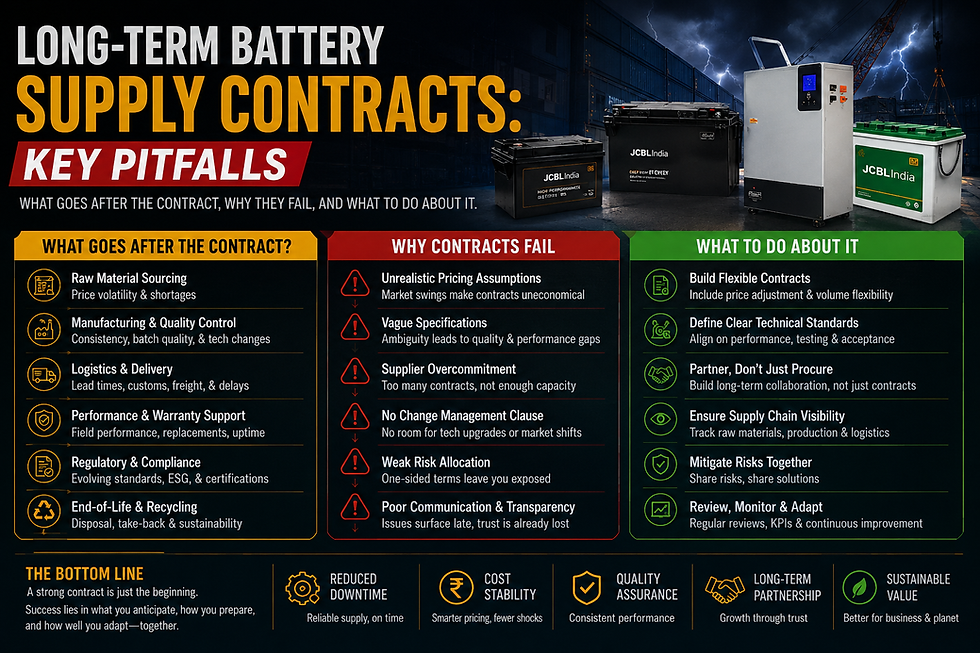
The main risks of long-term battery supply contracts include changing demand forecasts, supplier priority shifts, evolving battery technologies, raw material price volatility, changing business requirements, and reduced flexibility. Buyers should evaluate these risks carefully and incorporate mechanisms that allow contracts to adapt to changing market conditions.
Long-term battery supply contracts are often viewed as a source of stability.
For distributors, procurement teams and businesses that depend on a reliable battery supply, committing to a supplier for several years can seem like a practical way to secure pricing, ensure availability, and reduce procurement uncertainty.
On paper, that logic makes sense.
The biggest pitfall of a long-term battery contract is assuming that today's business conditions will remain unchanged throughout the agreement. While contracts can provide pricing stability and supply security, they cannot fully account for changes in demand, battery technology, supplier priorities, raw material costs, or regulatory requirements. As market conditions evolve, businesses may find themselves operating under terms that no longer align with their operational needs. The challenge is often not the contract itself, but the assumptions that were locked into place when it was signed.
However, many long-term battery contracts do not encounter problems because either party or batteries fails to fulfill their obligations. In reality, the greater challenge is that business conditions continue to evolve while the contract remains largely unchanged.
The agreement may still be valid.
The assumptions behind it may no longer be.
Before signing a long-term battery supply contract, it is important to understand the hidden risks that emerge when a static agreement operates within a rapidly changing market.
The Reality: Markets Change Faster Than Contracts
A battery supply agreement is typically negotiated based on current business conditions.
Both parties make decisions using information available at that moment:
Current demand forecasts
Existing production requirements
Available battery technologies
Raw material costs
Manufacturing capacity
The problem is that a 3-5 year contract is expected to survive in an environment where these factors can change significantly.
As a result, businesses often discover that the contract still works exactly as intended, but no longer aligns with their operational needs.
1. Your Demand May Change Faster Than the Contract
Many companies negotiate supply volumes based on current forecasts.
At the time of signing, those projections may appear realistic and well-supported.
A few years later, circumstances can be very different.
Your business may expand into new markets, launch additional products, secure larger customers, or experience unexpected shifts in demand.
When this happens, the supply agreement may become restrictive rather than supportive.
If demand exceeds original projections, the supplier may not be obligated to provide additional capacity. If demand declines, the buyer may still be committed to purchasing agreed volumes.
The contract has not failed.
The assumptions used to create it have simply become outdated.
2. Supplier Priorities Can Shift Over Time
Supplier relationships are rarely static.
When a contract is signed, your business may represent a strategically important account. Over time, however, the supplier's priorities can change.
For example:
New customers may enter the supplier's portfolio
Export opportunities may increase
Production capacity may become constrained
Market demand may exceed available supply
Although the supplier continues to honor contractual obligations, your position within their business may no longer be the same.
Service responsiveness, production flexibility, and strategic attention can all be affected by changes that were impossible to predict during contract negotiations.
A contract can define obligations, but it cannot fully preserve the dynamics of a business relationship over several years.
3. Technology Evolves While Contracts Remain Fixed
Battery technology continues to advance at a rapid pace.
Energy density improves. Cycle life increases. Manufacturing processes become more efficient. New chemistries enter the market.
A long-term contract may lock both parties into specifications that made sense at the time of signing but become less competitive over time.
For example, battery chemistries and energy density requirements continue to evolve across automotive, industrial, and energy storage applications. A battery technology considered optimal today may become less competitive as new designs and performance standards emerge.
Long-term agreements should therefore include flexibility for specification updates and product improvements.
Ironically, the contract may successfully protect the buyer from unexpected changes while simultaneously preventing them from benefiting from technological improvements.
This creates a difficult balance between stability and adaptability.
4. Raw Material Markets Remain Unpredictable
Battery manufacturing is heavily influenced by raw material markets.
Fluctuations in lithium, nickel, cobalt, lead, and other key materials can affect production costs throughout the life of a contract.
Even when agreements contain pricing adjustment mechanisms, significant market changes can create pressure on both buyers and suppliers.
Suppliers may face shrinking margins.
Buyers may face requests for renegotiation or revised commercial terms.
Neither scenario necessarily indicates poor planning. It reflects the reality that long-term contracts are often asked to manage uncertainties that no one can accurately predict years in advance.
5. Business Requirements Rarely Stay the Same
A contract is typically built around today's operational needs.
However, businesses evolve.
A company may introduce new products, adopt different manufacturing processes, enter new markets, or pursue sustainability initiatives that require different battery specifications.
When operational requirements change, previously suitable contract terms may become limiting.
The challenge is not that the agreement was poorly written.
The challenge is that future business requirements are difficult to forecast with complete accuracy.
6. Regulatory and Trade Changes Can Affect Long-Term Contracts
Battery regulations, import requirements, and trade policies may change during the lifespan of a long-term agreement. Export restrictions, transportation regulations, and evolving sustainability requirements can increase costs or affect delivery schedules.
Buyers should periodically review their battery sourcing agreements to ensure they remain aligned with regulatory developments and market conditions.
7. Flexibility Often Becomes More Valuable Than Certainty
One of the primary reasons businesses choose long-term contracts is to create certainty.
Yet certainty has limits.
In fast-moving industries, excessive rigidity can create its own risks.
Organizations that maintain some degree of flexibility may be better positioned to respond to market changes, adopt new technologies, and adjust purchasing strategies as conditions evolve.
This does not mean long-term contracts should be avoided.
It means they should be structured with enough adaptability to accommodate change.
How Buyers Can Reduce Long-Term Battery Supply Risks
Long-term battery contracts can still provide substantial value when designed thoughtfully.
Before signing, businesses should evaluate:
Whether volume commitments allow flexibility
How technology upgrades will be addressed
What happens if market conditions shift significantly
How pricing adjustments are managed
Whether periodic contract reviews are included
The goal should not be to eliminate uncertainty entirely.
The goal should be to create an agreement that can adapt as uncertainty unfolds.
The following framework can be used to quickly assess the battery manufacturer's manufacturing and supply chain capabilities.
Evaluation Area | Questions to Ask | Why It Matters |
Manufacturing capacity | Can output increase if demand grows? | Prevents shortages |
Engineering support | Can specifications be updated? | Supports evolving product needs |
Quality systems | How are warranty claims analyzed? | Indicates process maturity |
Export capability | How are documentation and logistics managed? | Reduces shipping issues |
Communication | How quickly are technical questions resolved? | Improves long-term collaboration |
Is a Long-Term Battery Contract Right for You?
Consider a longer agreement if:
demand is relatively predictable,
battery specifications are unlikely to change soon,
stable pricing is a priority,
and you have confidence in the supplier relationship.
A shorter or more flexible agreement may be preferable if:
product requirements are changing rapidly,
you're entering new markets,
demand forecasts are uncertain,
or battery technology is evolving quickly in your application.
What We've Learned from Supporting International Buyers
At JCBL India Batteries, we've found that the biggest challenges in long-term supply agreements are rarely caused by manufacturing defects. More often, they arise because customer requirements evolve after the contract is signed.
For example, buyers may:
expand into markets with different regulatory requirements,
revise packaging or labeling standards,
request higher cold-cranking performance,
adjust monthly purchasing volumes,
or introduce new product lines requiring different battery specifications.
These changes can often be accommodated more effectively when suppliers and buyers schedule periodic commercial and technical reviews rather than relying solely on the original contract terms.
Supply contract risks begin at the supplier evaluation stage. Here's is the definitive guide on how to assess manufacturers before committing.
This proactive approach helps businesses navigate the gap between the assumptions made when a contract is signed and the realities that emerge over the years that follow.
In a dynamic battery market, the ability to adapt is often just as important as the contract itself. There indeed are some Hidden Risks of Static Contracts in a Dynamic Battery Market but an experienced manufacturer is able to foresee the trends and adjust fluctuations.
Final Thoughts
The biggest risk in a long-term battery contract is not necessarily supplier failure, price volatility, or production disruptions.
It is the assumption that today's conditions will remain unchanged for the next several years.
Markets evolve.
Technologies advance.
Businesses grow.
Supplier priorities shift.
Contracts, however, are inherently static.
Before committing to a long-term battery supply agreement, business leaders should ask a simple question:
Which assumptions are we locking into place today, and how confident are we that they will still be true three years from now?
The answer may reveal risks that are not immediately visible in the contract itself.
FAQ’s
What are the disadvantages of long-term contracts with battery suppliers?
Long-term battery supply contracts can limit flexibility when market conditions change. Common disadvantages include fixed volume commitments, outdated battery specifications, pricing challenges, reduced access to newer technologies, and difficulties adapting to changing business requirements.
What should businesses consider before signing a long-term battery contract?
Businesses should evaluate volume flexibility, pricing mechanisms, technology upgrade provisions, supplier capacity, review periods, market-change clauses, and contingency plans for changing demand or operational requirements.
Can battery technology changes affect existing supply contracts?
Yes. Battery technology evolves rapidly, and long-term contracts may lock businesses into specifications that become less competitive over time. Without provisions for upgrades or product revisions, companies may miss opportunities to benefit from newer battery technologies.
Are long-term battery contracts better than short-term agreements?
Neither option is universally better. Long-term contracts provide supply security and pricing stability, while shorter agreements offer greater flexibility to respond to market changes, technological advancements, and shifting business requirements.
What happens if a supplier's priorities change during a long-term agreement?
A supplier may continue fulfilling contractual obligations while allocating more resources to other customers or markets. This can affect responsiveness, production flexibility, and overall relationship dynamics despite the contract remaining valid.


Comments